Dog Life Jacket Buying Guide: Fit, Buoyancy, and Handles
Affiliate disclosure: This article contains affiliate links. If you buy through them, we may earn a small commission at no extra cost to you. As an Amazon Associate I earn from qualifying purchases. Links go to Amazon search results for the product types we mention, not to specific products we have tested.
Not veterinary advice. This article shares general information about dog gear only. It is not a substitute for advice from your veterinarian. Check fit and supervise your dog with new gear, toys and chews, and ask your vet about health, diet, injuries or behaviour concerns.
A dog life jacket should be selected with a tape measure, not a breed label or a cute beach photograph. The important questions are whether it stays in position, allows normal movement, and gives you a practical way to assist your dog.
Even a confident swimmer still needs thoughtful water planning. The AKC's boating and water-safety guidance recommends a properly fitted life jacket for dogs swimming or riding on boats and stresses continuous supervision. A jacket is additional equipment, not permission to stop watching.
This dog life jacket buying guide separates measurable features from broad safety promises, then gives two real products to investigate using your dog's dimensions.
When swimming ability is not enough
A dog that retrieves happily from a quiet shoreline has not demonstrated readiness for every boating situation. The AKC's swimming guide explains that dogs can become tired or disoriented and that a flotation device is essential for boating, where an unexpected fall may involve rough water or currents.
That does not make difficult water an appropriate place to take a dog wearing a jacket. Conditions and the dog's experience still determine whether an outing should happen at all. Choose a manageable location, a clear exit, and attentive human supervision rather than using a product to justify a more ambitious trip.
If your dog has a health condition or you are unsure whether swimming is suitable, speak with your veterinarian before planning water exercise. The AKC's water-safety advice places individual fitness and preparation alongside equipment.
Measure before choosing a size
Take measurements while your dog stands normally. Keep a note on your phone with the date, measurements, and the jacket model you are considering.
Chest girth
Wrap a soft tape around the widest part of the rib cage, usually behind the front legs. This is the main sizing measurement for many dog flotation jackets, including the Ruffwear Float Coat.
Do not assume the size matches a winter coat or harness. A medium is a label within one product line, not a standard canine measurement.
Neck and body proportions
Measure the neck at the location shown in the model's instructions and check the neck adjustment range. Also record back length and weight where the sizing chart requests them. The AKC's jacket-fit guide recommends collecting dimensions rather than relying on weight alone.
A deep chest, narrow neck, long back, or broad shoulders can complicate the fit even when one measurement falls within the chart. When dimensions disagree, ask the manufacturer instead of automatically choosing the largest size.
Between sizes is a model-specific question
Do not apply one blanket “size up” rule. Ruffwear's Float Coat instructions advise sizing down between sizes, while Outward Hound's Granby guidance recommends sizing up toward the higher end of its girth range. Follow the exact product's instructions and assess the resulting fit; neither rule transfers automatically to another model.
What good fit needs to accomplish
The AKC life jacket guide says a jacket should fit snugly, allow horizontal swimming, and let the dog sit or lie down. It suggests room for two fingers under the straps.
Use that as a starting check alongside the manufacturer's instructions, not the only check. On land, observe your dog standing, walking, turning, sitting, and lying down. Inspect whether the front panels remain centered and whether the straps stay where they were adjusted.
During a calm, closely supervised shallow-water introduction, check the fit again when wet. The same AKC guide recommends observing buoyancy, range of motion, and wet fit. A jacket that rotates or rides up is not solved by ignoring it because the chart said the size was correct.
For ordinary walking equipment, our dog harness fit guide covers a separate fitting process. Do not assume that a flotation jacket also serves every purpose of your regular harness.
Buoyancy: look beyond the word “float”
Look at where the flotation material sits around the dog's body and what the manufacturer says the design is intended to do. Avoid treating a colorful cover, thick-looking fabric, or a product name as a meaningful performance standard.
A front neck float is a feature of some models, not a promise that every dog's head will remain in the same position in every circumstance. The AKC swimming article notes that extra flotation under the chin may be useful when additional support is needed. Your dog's actual fit and supervised introduction still matter.
Read restrictions carefully. For example, Outward Hound describes the Granby as a flotation aid for a conscious dog in calm water in its safety instructions. Do not turn that description into a guarantee for unconscious dogs, surf, or whitewater.
Grab handles and rescue handles
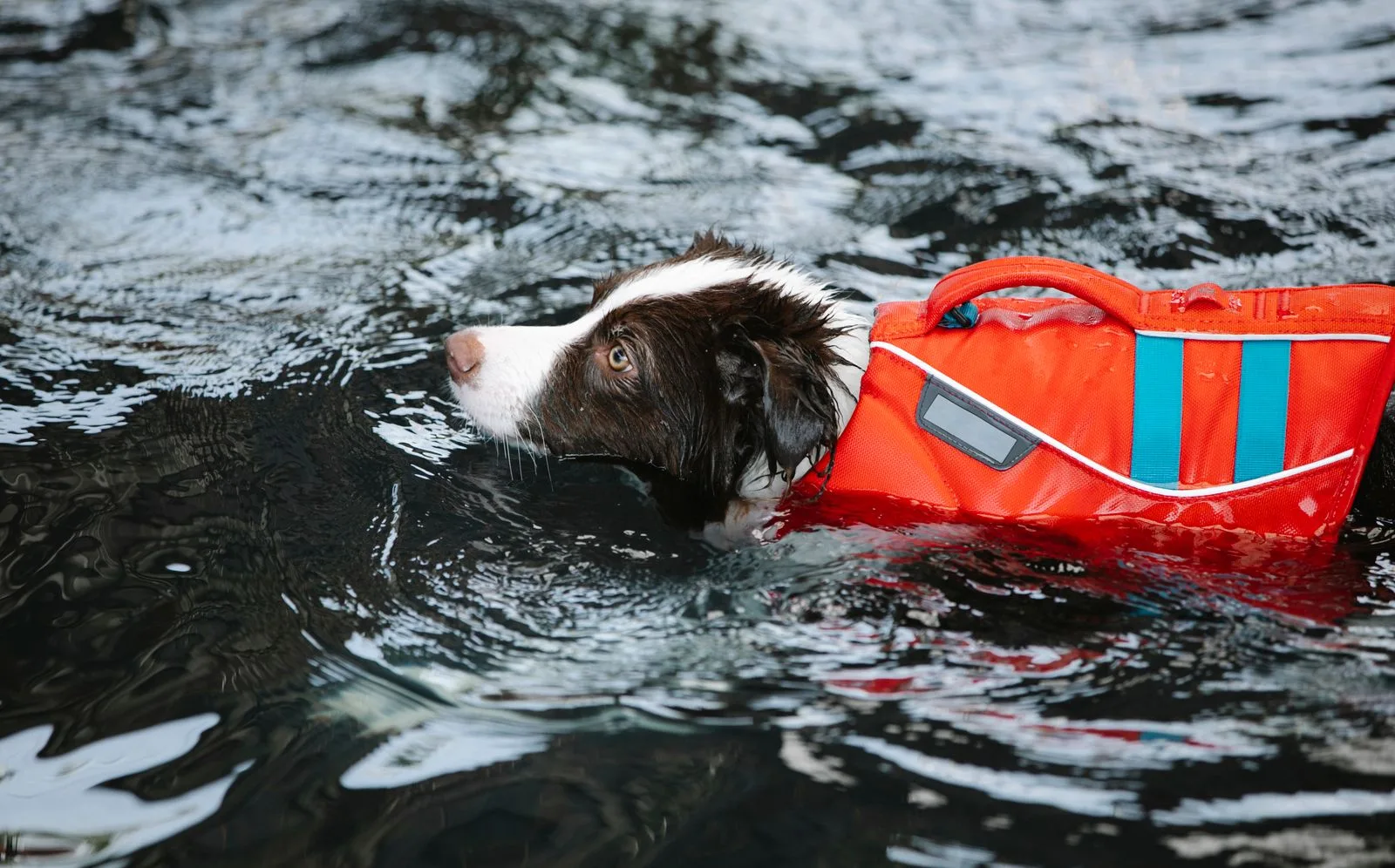
A top handle should be easy for your hand to find while the jacket is on your dog. Check its opening, location, stitching, and the manufacturer's directions for use. The AKC advises looking for a handle sturdy enough to assist a dog out of the water.
But “grab handle” and “rescue handle” are not universal lifting ratings. One model may permit assistance during routine water activities; another may restrict lifting to emergencies. The Granby safety label specifically says to use its rescue handle for emergency lifting only.
Do not suspend your dog from a handle on dry land to see what happens. Plan how you would assist the dog's whole body at your chosen exit, and follow the model's instructions. A handle also does not make a large dog easy for one person to retrieve onto a high boat deck. If you cannot describe a workable exit plan, change the outing.
Two product directions to consider
These options illustrate different constructions and instructions. They are not a ranking based on hands-on trials, and choosing the correct shape matters more than choosing a familiar name.
Ruffwear Float Coat
Suits: owners considering a structured flotation jacket for repeated, supervised water outings.
Ruffwear describes strategically placed foam panels, an adjustable telescoping neck closure, a reinforced low-profile handle, and reflective accents on the Float Coat product page. Its chest-girth chart and separate neck measurements give you concrete numbers to check.
The important shopping question is whether the neck range and torso shape work together for your dog. Check the current model rather than transferring measurements from a used or older version. Browse Ruffwear Float Coat options, then confirm the size and included instructions before ordering.
Outward Hound Granby Splash
Suits: owners seeking a straightforward flotation-aid design for closely supervised calm-water use.
The Granby product page lists adjustable straps, a front neck float, and bright colors with reflective accents. Handle configuration varies: extra-small and small have one handle, while medium through extra-large have two.
Its calm-water and emergency-handle restrictions are important purchase details, not fine print to skip. You can browse Outward Hound Granby Splash jackets and check the exact size-specific construction. Do not choose by handle count alone.
Visibility, fasteners, and small conveniences
Bright colors and reflective trim are useful selection features identified by the AKC jacket guide. Choose a color you can distinguish from your usual surroundings, but do not mistake reflection for an active light or a jacket for a tracking device.
Other details affect daily use:
- Can you reach and close the buckles without twisting the jacket?
- Is excess webbing secured according to the instructions?
- Is the leash attachment clearly identified, if one is provided?
- Can the wet jacket be rinsed and dried without an awkward disassembly?
- Is the care label still available after unpacking?
If the trip involves driving first, pack a separate travel setup. Our dog car travel checklist keeps road equipment distinct from water equipment.
Before each outing
The AKC water-safety guide recommends inspecting the jacket for wear and ensuring a secure fit before use. Check buckles, webbing, seams, and flotation panels rather than only the exterior color.
Recheck measurements as a puppy grows or your dog's body changes. Assign one person to watch the dog continuously, provide breaks, and know the exit route. Follow the model's washing instructions and let it dry before storage; putting wet gear directly into a closed bag is not a useful maintenance routine.
FAQ
Does a dog that swims well need a jacket on a boat?
The AKC recommends flotation equipment for boating, including for dogs that can swim. Swimming ability does not remove the need for supervision or a realistic retrieval plan.
Is weight enough to select the size?
No. Use the exact model's girth chart and check neck and body dimensions. Weight is a cross-check when the manufacturer requests it, not a substitute for measurements.
Can I leave my dog alone in a pool with a jacket?
No. The AKC's water-safety guidance calls for continuous supervision, including with strong swimmers. A jacket does not replace that responsibility.
Should the handle have one loop or two?
Neither number settles suitability. Consider your dog's size, handle access, construction, and the instructions for that model. Fit, permitted use, and a workable exit plan come before a feature count.
About the author: This article was researched and written by the Dog Gear Hub Editorial Team. We compare dog gear and gifts using manufacturer and retailer information and owner reviews, and we say clearly when we haven't tried a product ourselves.
Read next: Dog Car Travel Gear Checklist: Safe Restraints and Trip Essentials →