Best Puzzle Toys for Dogs: Choose by Play Style and Difficulty
Affiliate disclosure: This article contains affiliate links. If you buy through them, we may earn a small commission at no extra cost to you. As an Amazon Associate I earn from qualifying purchases. Links go to Amazon search results for the product types we mention, not to specific products we have tested.
Not veterinary advice. This article shares general information about dog gear only. It is not a substitute for advice from your veterinarian. Check fit and supervise your dog with new gear, toys and chews, and ask your vet about health, diet, injuries or behaviour concerns.
The best puzzle toys for dogs are not necessarily the ones with the most locks, drawers, or difficulty levels. A useful puzzle gives your dog an understandable way to reach food, suits the way they like to interact, and is realistic for you to clean after use.
Start with a simple question: does your dog enjoy nudging, searching, licking, or moving things with a nose or paw? Choose one format that matches that behavior rather than buying a collection of unrelated gadgets.
Puzzle toys add an activity to the day. They do not replace walks, bathroom breaks, interaction, or an individual care plan. The AKC describes puzzle toys as food-holding devices that offer physical and mental challenges, not as a substitute for every other part of a dog's routine.
Put supervision ahead of difficulty
A food puzzle is not automatically a chew toy. Some have removable covers or moving pieces, and even a familiar toy can be damaged. The AKC's toy-safety discussion warns that dogs may swallow unsuitable toys or torn-off pieces and that swallowed objects can cause intestinal problems.
Choose a size and construction appropriate to your dog's mouth and behavior, supervise throughout, and remove damaged items. If you suspect your dog swallowed a piece, contact your veterinarian or an emergency veterinarian promptly. Do not wait for an article to tell you whether a particular missing part will pass.
If your dog routinely dismantles objects, our toys for strong chewers guide helps distinguish chewing needs from interactive puzzle play. A high difficulty number says nothing about resistance to being chewed apart.
Match the format before the product
| Your dog's usual approach | Format to investigate | First-session setup |
|---|---|---|
| Nudges objects with a nose | Wobble feeder | A few pieces that dispense easily |
| Explores lids and openings | Sliding or flip-lid board | Several compartments left open |
| Enjoys moving a tray | Spinning puzzle | One accessible layer, with no extra blockers |
| Searches through soft material | Snuffle mat | Food placed visibly on top |
| Licks rather than pushes | Food-stuffable rubber toy | An easy, familiar filling near the opening |
These are starting points, not personality labels. A dog can enjoy several formats, and a dog that dislikes one board may still enjoy another kind of food activity.
KONG Wobbler: a moving food dispenser
Suits: dogs that enjoy nudging a substantial toy and following the food it releases.
The KONG Wobbler sits upright and dispenses food as it wobbles, rolls, and spins. The body unscrews for filling and cleaning. This makes it a different activity from lifting small covers on a flat puzzle board.
Its practical appeal is the simple interaction: movement produces a reward. The tradeoff is space. It can travel around a room, so plan a suitable play area rather than placing it beside stairs, under a crowded desk, or in a narrow gap where the dog cannot follow it.
KONG explicitly labels the Wobbler not a chew toy, requires supervised use, and says to discontinue use if damaged in its instructions. If your dog settles down to gnaw on the body instead of moving it, change the activity.
Browse KONG Wobbler food-dispensing toys and check the exact size guidance. Do not assume that a familiar brand's unrelated rubber toy uses the same sizing or play instructions.
Nina Ottosson Dog Brick: lids, sliders, and removable covers
Suits: dogs ready to explore a stationary board with several different actions during hands-on play with you.
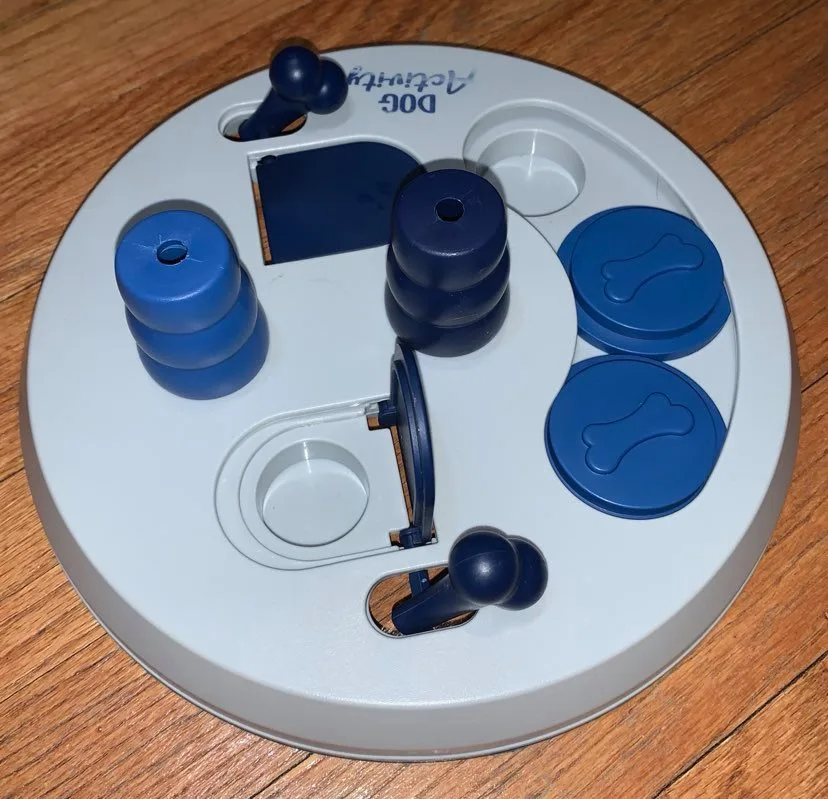
The Dog Brick product page describes flip-lid compartments, sliding sections, and removable bone-shaped covers. It is labeled Level 2 within that product line. Those different actions let you present a simpler version first rather than immediately hiding every piece of food behind every obstacle.
Begin with open compartments and easily visible rewards. Demonstrate one movement, then give the dog room to investigate. You do not need to use every removable piece in the first session.
The tradeoff is parts management. Know which pieces belong to the board, inspect them before use, and collect them afterward. Outward Hound's Dog Brick safety instructions require close supervision, say not to allow chewing of the game or pieces, and direct owners to store the toy when empty.
Browse Nina Ottosson Dog Brick puzzles. Check the specific version because product-family names do not always describe identical layouts.
Nina Ottosson Dog Tornado: rotating layers
Suits: dogs that already enjoy nose or paw interaction and owners who want a spinning-tray format rather than a rolling dispenser.
The Dog Tornado design uses rotating layers with food compartments and optional bone-shaped covers. The basic action differs from the Brick's flip-and-slide arrangement, so it can add variety without requiring a completely unfamiliar food game.
Start with a readily accessible compartment and leave extra blockers out until the dog understands the spinning action. Difficulty labels belong to a manufacturer's range; they do not predict how quickly your individual dog will understand a particular movement.
The tradeoff is that cleaning involves multiple surfaces and compartments. Look closely at the washing directions and layout before deciding it will be easier to maintain than a simple dispenser. Browse Nina Ottosson Dog Tornado puzzles and choose the intended model rather than a visually similar listing.
A washable snuffle mat: searching rather than moving hardware
Suits: dogs that enjoy finding food among folds while an owner supervises nearby.
A snuffle mat changes the task from moving plastic pieces to searching among fabric strips or pockets. The first introduction can be very simple: place a small amount of food visibly on the surface before making any hiding places more elaborate.
The maintenance tradeoff is fabric. Check how the mat is washed, how it dries, and whether food can lodge deep in seams. If your dog pulls or chews the fabric instead of searching, stop the session. The AKC's toy-selection advice emphasizes choosing appropriate construction and removing damaged toys rather than allowing dogs to consume materials.
Browse washable dog snuffle mats for this format, but do not treat the word “washable” as proof of a particular machine-wash cycle. Read the care label for the exact mat.
What about lick mats and stuffed toys?
A lick mat or food-stuffable toy may suit a dog that prefers stationary food access to manipulating a board. It is still an activity to supervise, not a way to make a dog disappear from your attention.
Our lick mat topping guide and frozen treat toy guide cover those neighboring formats. For a first session, keep the task straightforward rather than combining a new toy, an unfamiliar food, and a hard frozen filling at once.
If your dog has dietary restrictions, ask your veterinarian what food and quantities can be used before changing the routine. A puzzle needs suitable food, not a special recipe or an expensive assortment of treats.
A difficulty ladder that starts with success
Manufacturer levels are useful labels, but your dog's response matters more. The AKC's puzzle overview recommends matching the toy to the dog's size and jaw power; a challenging mechanism does not compensate for unsuitable construction.
Use this practical sequence:
- Present the empty toy and allow calm investigation.
- Add a small amount of familiar food in visible locations.
- Demonstrate one action if the design permits it.
- Let the dog repeat that action before adding another step.
- End the session while participation is still easy and purposeful.
If your dog abandons the toy, turns it over, or starts biting pieces, simplify rather than making the task harder. A dog walking away has not failed an intelligence test. The format, food, location, or challenge may simply be wrong for that session.
Food planning and cleanup
Plan the food before filling every compartment. You can set aside an appropriate portion of the dog's usual meal rather than adding a large amount of extra treats. If you are managing weight, allergies, or another dietary concern, your veterinarian should guide the amount and food choice.
Use dry food only where the model allows it, and check dispenser openings against the actual kibble shape. A toy that clogs repeatedly is not providing a clearer puzzle. For wet fillings, consider whether you can reach and wash every food-contact surface.
KONG lists the Wobbler as top-shelf dishwasher-safe, while Outward Hound describes hand washing for the Dog Brick on their respective Wobbler and Dog Brick pages. Follow the model's directions instead of putting every puzzle through the same cleaning cycle.
Build a small rotation, not a toy mountain
Start with one puzzle and keep notes: what action did the dog enjoy, what needed help, and how long did cleanup take? Your second purchase should solve a specific gap rather than duplicate a toy that already works.
Our indoor enrichment ideas add variety beyond commercial food puzzles. A useful rotation includes interaction with you and ordinary daily activities, not simply increasingly complicated plastic boards.
FAQ
Which puzzle suits a complete beginner?
Choose a format you can make very easy: open compartments, food on top of a mat, or an accessible dispenser. Simplicity and understandable rewards matter more than buying the highest difficulty level.
Can puzzle toys be left out while I work elsewhere?
The products discussed here require supervision. The Dog Brick and Wobbler instructions explicitly require it. Being at home is not the same as actively watching the session.
Will a puzzle cure separation anxiety?
Do not treat a food toy as treatment. Discuss ongoing distress with your veterinarian and an appropriately qualified behavior professional. Choose puzzles for suitable supervised activity, not a medical or behavioral promise.
Does solving a puzzle quickly mean I need a harder one?
Not necessarily. Repeating an enjoyable, manageable activity can be worthwhile. Add difficulty only when it improves the game for your dog, not because a stopwatch suggests the toy has stopped being useful.
About the author: This article was researched and written by the Dog Gear Hub Editorial Team. We compare dog gear and gifts using manufacturer and retailer information and owner reviews, and we say clearly when we haven't tried a product ourselves.
Read next: Indoor Dog Enrichment Ideas for Cold, Rainy or Snowy Days →